Archive

Archive for the ‘Horses’ Category

Caring for your pony – Grooming

May 30th, 2010

Grooming your pony

Grooming your pony

Besides water, food and sufficient exercise, another important aspect in horse care is grooming. Whether you own or loan a pony, or simply help out at a friends house, grooming is an important skill you need to learn beside riding.

As well as keeping a ponies coat clean, grooming promotes blood flow, stimulates breathing, strengthens the bond between you and him /her and it removes dead skin cells and dead hair.

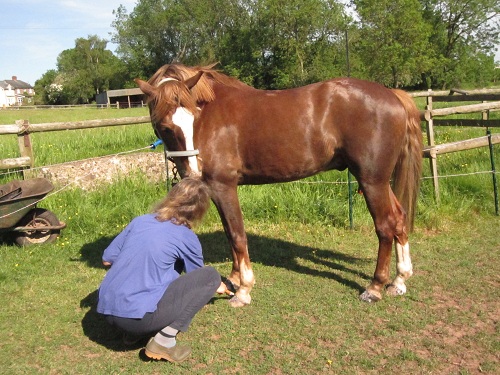
If you think of grooming as flicking a random brush over your pony, then you are mistaken. That certainly is NOT the way to groom a pony. When you groom a pony you should do it methodically so that you do not flick dirt back on to a part of the pony that you have already brushed. Start by picking out the hooves but remember to pick them out from heel to toe as otherwise you may hurt the frog(!) (the sensitive middle part of the bottom of the hoof) if your hand slips.

Check for signs of thrush (smelly feet, black discharge) and carefully put the ponies hoof down. Next, start grooming the mane and use a body brush or your fingers to comb the mane till you can go through it without trouble. A de-tangler spray would really help.

Remove mud from the coat with a dandy brush and and then use a body brush to remove grease and scurf. After a few strokes with the body brush use a metal curry comb to remove the hair from the body brush. Note: the metal curry comb is only used for cleaning the body brush, and should NEVER be used on a pony.

Now set to work with the tail, but stand to the side to avoid getting kicked and pull the tail to the side. Use a body brush or your fingers because, however tempting it may seem to use a plastic curry comb, this is not advised as it breaks the hair and can give your pony split ends.

Now as a finishing touch, why not add some hoof shine?
Otherwise you can use effol or another well known hoof strengthening cream or paste.

Horses , , , ,

War Horse – Story of a boy and his horse in First World War

May 6th, 2010

War Horse to be made into a Film
Several big screen films has been made about horses in various context including black beauty which traces the journey of a horse from the countryside field he was born to a big city. War Horse a novel by Michael Morpurgo which was successfully adapted for theatre has been a success at the West End for quite a while now, recently acclaimed file maker Steven Spielberg bought the film right to War Horse recently and he has just announced that he will be directing the film adaptation of War Horse.

War Horse is a touching story about a boy’s love for his horse and their mutual suffering amid the carnage of the First World War, the story not only explore the horrors of war from both the boys viewpoint and his horse’s viewpoint and how it affected them both.

In previous films, Spielberg has explored the relationship between children and other creatures, bringing out sides of children and seemingly dumb creature that actually have a lot to offer, his extra terrestrial film (ET) did just that; communication and understanding between ET an alien and child formed the core of the story. Spielberg also directed another film exploring the survival of a boy in the Japanese occupation of Shanghai which was based on J G Ballard’s autobiography; Empire of the Sun.

Theatre purist argue that no amount of magic Spielberg and his DreamWorks studio can apply to War Horse to make it a memorable as the stage version which is still going very strong at New London Theatre and it due to open in New York in 2011.

Horses , ,

Rural votes in general election 2010 – two horse race?

May 1st, 2010

General Election 2010 - Rural Votes

The author of this article is not a fan of horse racing but it is quite interesting that Lib Dem are using horse racing analogy to target rural votes . Imbued with new confidence from the surge they enjoyed in opinion polls after the first TV debate where their leader Nick Clegg is said to have won, Lib Dems are now on the all out offensive to capture rural votes by targeting Labour members they think could easily be converted to voting for them at constituencies where they feel Labour voters can easily be persuaded to vote for them to keep the Conservatives out.

One thing that is true in the LibDems literature is the fact that most Labour support tends to be in the cities rather than the countryside as most rural constituencies tends to elect a Conservative or Liberal MP.

Horses , , ,

Horse riding basics – how to sit correctly

April 29th, 2010

This rider is not sitting correctly
Horse riding, the art of keeping a horse between you and the ground, has many important aspects, including sitting corectly.
General position
The basic position for walk and halt is sit up straight and tall, keep your elbows in a diagonal line with the horses mouth (your arms should never be straight), keep your heels down. keep the ball of your foot in the stirrup,ensure your shoulder, hip and heel are in a straight line.

Hands
When riding the position of your hands is important. How you hold the reins is also important, you should be able to feel a horses mouth without jabbing or pulling at the reins. Your instructer will tell you how to hold the reins correctly, but remember, always keep your thumbs on top and don’t rest your hands on the saddle or the horses neck.

Stirrups
Stirrups need to be different lengths for different activities. Dressage is done with long stirrups and requires confident riders with a deep seat.
For beginners, stirrups should be as long as your arm from finger tip to arm pit, to give a general idea.

Jumping position
When you start to jump your instructor will explain every thing you need to know but it is good to come prepared.
Approach
The way you approach a jump is very important. Keep your heels down, look ahead, keep your normal position and ride positively.
Take off
As you take off the only change in your position should be that you fold forward at your hips. Keep your heels down!
Moment of suspension
Keep the same position as above.
Landing
As you land, keep your heels down, they are your anchor, and sit up so that as you make the getaway, you are back in your usual position.

To achieve a good seat there are some exercises you can do. These include riding without stirrups and practicing sitting still (although this will most likely not be done in your first lesson).

Horses , , , , , ,

Spotty the Dalmatian Foal – Dotted Dartmoor pony spotted in Devon

April 13th, 2010

Spotty the Dalmatian Foal – Rare polka dotted Dartmoor pony spotted in Devon


At first glance, the ramblers that found spotty the pony probably think they found the missing dalmatian dog from the 101 dalmatian  but then spotty is way too big to be mistaken for a dog. Perhaps a young Zebra that has escaped from a zoo? that is wrong too.
Cliff-top ramblers spotted this photogenic foal at Wembury Point in Devon. Spotty’s parents were part of wild horses and ponies that grazed and lived in Dartmoor until they were moved to  Wembury Point to help keep the grass short. Nickname spotty by the rambler who spotted him but called Pongo by its owner.

Spotty or Pongo as its owner prefers to call him has an unusually colouring. His mother is a brown and his father where he is though to have got his colouring is from the stock of ancient British Spotted breed which used to be quite common.

Spotty who was born a week ago is said to be going back to  Dartmoor on Friday to join the rest of the herd. He will be back to Wembury Point when he is a little older to come back and graze.

Do you own or know of a horse or pony with similar colouring to Spotty? why not share the picture with us by commenting on this post and posting a link to your spotted horse?

The British Spotted Pony society describes the characteristics of spotted ponies as follows:
A quality pony with adequate bone and substance, hardy and active with real pony character of miniature, riding or cob type up to and including 14.2 hh.
Breed Characteristics:
All ponies must display some or all of the following:
White sclera around the eye.
Mottled skin – this part-dark, part-pink skin is usually most evident around the genitals, lips, muzzle, eyes and inside the ears.
Striped hooves.

You can find more information about spotted horses at  British Spotted Pony Society

Horses , , , , , ,